Exterior Paint Fading or Chalking Fast in the Sun? Why and What Lasts
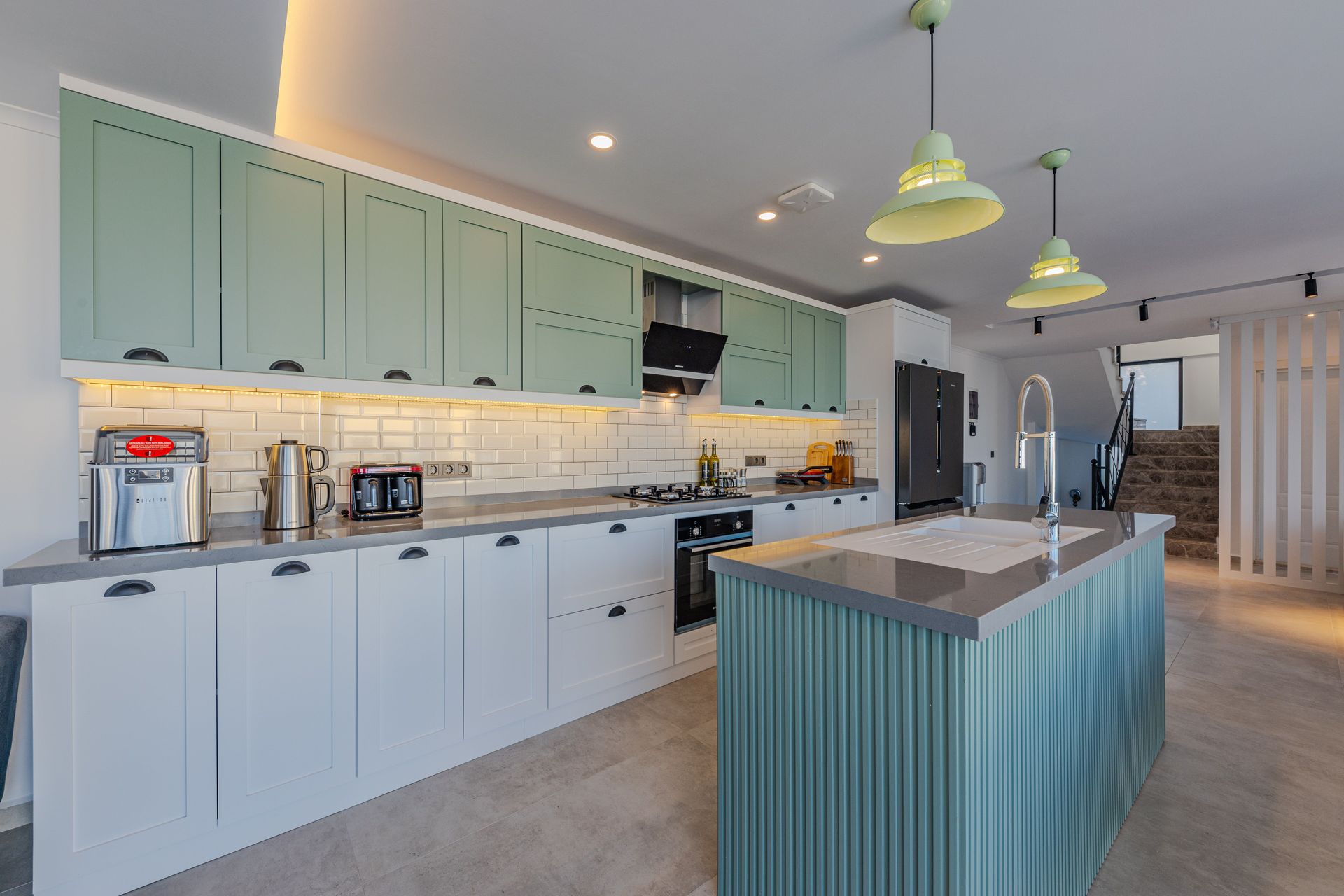
Why your cabinets look worn out
The finish fails first, almost every time. On the cabinets we open up, the wood underneath is usually fine while the topcoat has given out. Years of cooking grease, steam, and hand oils break down the original factory coating, especially on the doors closest to the stove and sink. That is why those doors always look the worst.
Three things drive most of the wear we see. Grease buildup softens and yellows the finish near the range. Moisture from the sink and dishwasher swells the bottom edges of nearby doors. And daily handling wears a dull patch right around every knob and pull. None of that means the cabinet itself is finished. It means the coating that protected it is finished, and a coating is something we can replace.
Quick Answer: Exterior paint fades and chalks because ultraviolet light steadily breaks down the two things that keep a finish looking new: the pigment that holds the color and the resin binder that locks that pigment to the wall. As the binder gives out, loose pigment turns to a powdery film you can wipe off with your hand. Strong, direct sun speeds all of it up, which is why the south and west walls always look worn first. What lasts is the combination that resists UV at every layer: a clean, well-prepared surface, a quality 100 percent acrylic coating with UV-stable pigments, lighter or oxide-based colors on the hardest-hit walls, and two full coats applied at the right thickness.
You painted the house a few years back, it looked sharp, and now one side has gone flat and dull while the other still holds its color. Run a hand across the faded wall and your palm comes away with a chalky, powdery residue the same shade as the paint. The trim looks tired, the deep color you chose has washed out to something paler, and it is always the walls that catch the most sun that went first. Nothing is peeling, exactly, but the finish clearly is not protecting anything anymore.
That combination of fading and chalking is one of the most common things you run into on homes across Ojai, Ventura, and the inland stretches of the county, where the sun is strong and relentless for most of the year. It is not a sign you bought bad paint or that the crew did something wrong, at least not always. It is the predictable result of ultraviolet light working on a coating day after day. Here is what is actually happening at the surface, why the sun here is so hard on a finish, and what genuinely makes an exterior job hold up instead of dusting off in a few seasons.
What Fading and Chalking Actually Are
Fading and chalking look like one problem, but they are two separate failures happening in the same film, and understanding the difference tells you a lot about the coating you have.
Fading is pigment breakdown
The color in your paint comes from pigment particles suspended in the film. Ultraviolet light carries enough energy to break the chemical bonds inside those pigments, a little more every hour. This photodegradation is cumulative and permanent, which is why a faded wall cannot be cleaned back to its original shade.
Chalking is binder failure
Pigment does not stick to the wall on its own. A resin binder holds it in a continuous, protective film. UV attacks that binder too, and as it degrades, surface pigment loses its grip and sits loose. That powder is freed pigment, and heavy chalking early means the binder failed.
You will often see both at once. The wall reads as lighter and duller because pigment is degrading, and it feels dusty because the binder holding the surface layer has started to let go.
Why the Sun Here Is So Hard on a Finish
Not every wall ages at the same rate, and the pattern is never random. The sun decides which surfaces wear first, and in this part of the county it pushes coatings harder than a lot of homeowners expect.
Orientation drives most of it
South-facing and west-facing walls take the longest, most direct hours of sunlight, and they routinely break down two to three times faster than the shaded north side. When you notice fading, it almost always starts on the sun sides, and that lopsided wear is the clearest fingerprint that UV is working.
Heat compounds the UV
Direct sun does not just deliver ultraviolet light, it also drives up surface temperature, and higher heat speeds the chemical breakdown of both pigment and binder. A dark-colored wall in full afternoon sun can climb well past 150 degrees, which is exactly why deep tones fade faster and show it more obviously.
The color you picked matters
Bright reds, strong blues, and vivid yellows tend to rely on organic pigments, the most vulnerable to UV. Earth tones and terracottas built on iron oxide pigments hold up far better, because oxide pigments are among the most lightfast available. Whites and light neutrals fade least, partly because they reflect more radiation.
Coastal air adds a second front
Closer to Ventura and the coast, salt and constant atmospheric moisture create a mildly corrosive environment that works alongside the sun. Repeated wetting and drying cycles flex the paint film, and that movement helps loosen a binder the UV has already weakened, nudging a coating toward chalking sooner than inland.
Tip: To tell chalking apart from ordinary dirt, wipe a damp cloth across the faded wall. If the residue matches the paint color, that is chalk, meaning the binder is breaking down. If it is gray or brown and unrelated to the paint, you are mostly looking at surface grime that a good wash will handle.
What Actually Makes an Exterior Finish Last
Here is the part that matters if you are about to repaint and do not want to be back in the same spot in three years. A finish that holds its color in strong sun is not one lucky product choice. It is several decisions stacked together, and skipping any one of them tends to be what shortens the job.
Preparation sets the ceiling
Chalking is irreversible once it starts, so you cannot bury it under new paint and expect adhesion. That powdery layer must come off through pressure washing and scrubbing until sound and clean. Cleaning, sanding, and priming are what a durable finish is built on.
The binder is what fights the sun
A quality 100 percent acrylic coating gives the strongest, most flexible binder for this exposure, holding pigment and resisting UV far better than budget latex or oil enamels. Better coatings carry UV absorbers that soak up radiation before it reaches the pigment beneath.
Pigment choice buys you years
On the walls taking the worst sun, colors built on stable oxide pigments outlast organic ones. That is not a sentence to beige. It means bold, dark looks belong on protected elevations, while punishing south and west walls do best in lightfast tones.
Film thickness is not a detail
Two full coats at the recommended thickness give a denser pigment layer and a thicker sacrificial barrier against UV. The top coat takes the abuse and protects everything beneath. Thin single coats never build enough film, fading unevenly a couple of summers later.
Warning: Painting a hot, sun-baked wall in the middle of the afternoon works against you. When a surface is too hot, the coating flashes dry before the film can form properly, and a film that never coalesced correctly has weaker UV resistance from the start. Following the shade around the house and working on cooler surfaces is part of why a finish lasts, not a minor scheduling preference.
Getting Ahead of It Instead of Chasing It
Once you know the sun is the driver, you can stop treating fading as a surprise and start managing it. A simple annual wash keeps chalk and grime from building into a thick layer and lets you see the true condition of the finish underneath. Watching the south and west walls, since they always report trouble first, gives you an early read on when a repaint is coming rather than being caught off guard by a wall that has gone fully dusty. And when it is time, matching the coating and color strategy to each elevation, rather than treating every wall the same, is what turns a repaint into something that lasts closer to a decade than a handful of seasons.
Frequently asked questions
Is chalking a sign the paint was defective?
Usually not. Every exterior paint gives up something to ultraviolet light, so light chalk after years of sun is normal. Heavy chalking within a season points to a weak binder or thin application.
Can I just paint over a faded, chalky wall?
Not directly. The powdery layer must be washed and scrubbed off first, because paint over chalk bonds to dust and peels early. Once cleaned back to a sound, prepped surface, fresh coating adheres properly.
Why does one side of my house look so much worse than the others?
Orientation. South-facing and west-facing walls take the most prolonged sun and often break down two to three times faster than the shaded north side. That uneven wear signals UV exposure, not age.
Do darker colors really fade faster in the sun?
Yes. Dark colors absorb more heat and UV energy, speeding the breakdown of pigment and binder, and the fading shows more against the original shade. Many bold colors also use less UV-stable organic pigments.
What kind of paint holds its color longest here?
A quality 100 percent acrylic coating with UV-stable, oxide-based pigments holds up best against steady sun. Pair it with lighter, lightfast colors on the most exposed walls, applied in two full coats over prepped surfaces.
How often should I expect to repaint on the sunny side?
It depends on exposure, color, and product, but sun-facing walls always need attention first. A quality finish holds for years, while a thin job on a west wall tires within seasons.
Keeping Color on the Wall Where the Sun Is Relentless
Fading and chalking are not a mystery and they are not bad luck. They are ultraviolet light doing exactly what it does to pigment and binder, sped up by the strong, direct sun that hits homes across this stretch of the coast and valleys. The finish that lasts is the one that fights UV at every layer: a clean, chalk-free surface to build on, a durable 100 percent acrylic coating with real UV protection, colors chosen for the exposure each wall actually gets, and enough film thickness to take the abuse. Get those working together and your color stays on the wall for years instead of washing out a couple of summers after the crew leaves.
Get an exterior finish built to hold its color in strong sun — When fading and chalking show up first on your south and west walls, the fix is not just fresh paint but the full system: washing and scrubbing off the chalk, prepping and priming a sound surface, choosing UV-stable colors matched to each elevation, and laying down two full coats of a durable acrylic coating at the right thickness. Serving Ojai and Ventura County, California, McKay's Painting Inc
brings 50-plus years as owner-supervised repaint specialists to exactly this kind of sun-driven wear. Reach out to schedule an
exterior evaluation and get a finish designed to last.
Share this article